
Rolly Legs
VOODOOArcade
4.43.69K Reviews
- Version
- 3.02
- Installs
- 10.00M
- Age Rating
- Everyone
Screenshots
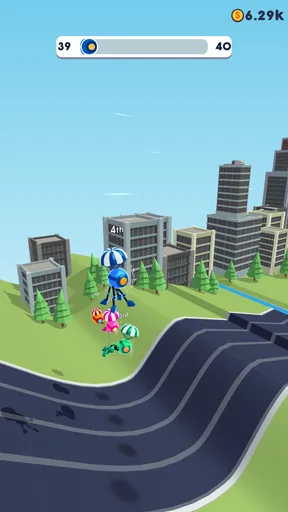

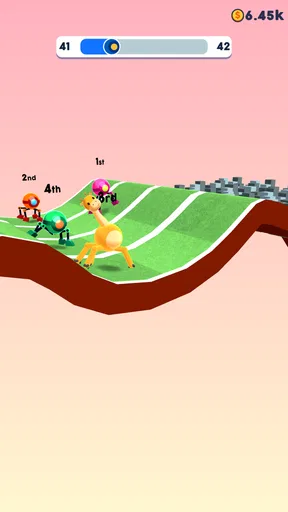
Our Review of Rolly Legs
 Analysis by Appyee
Rolly Legs is the kind of arcade game I can open for a few spare minutes and understand almost immediately. I control a small robot that moves through courses by rolling, walking, and climbing, with the simple goal of reaching victory before the route gets the better of me. That sounds easy, but the appeal comes from making tiny movement decisions at the right moment rather than from a complicated rule set.
After spending time with it, I see the game as a good fit for players who enjoy short, tactile challenges and a little repetition. It is free to download, aimed at Everyone, and developed by VOODOO. Its broad audience is reflected in its average rating of 4.4 from around 124 thousand ratings, while more than 10 million installs show how naturally this sort of quick arcade experience fits on mobile devices.
How the robot’s movement shapes the experience
The central idea is wonderfully direct: the robot’s legs and rolling motion are not just decoration, they are the whole reason the game feels different from a standard runner. I am constantly judging whether to keep momentum, adjust my movement, or approach a climb more carefully. A conventional endless runner often trains me to react to obstacles in a predictable lane-based rhythm. Here, the character’s physical movement makes each section feel more like a small balancing problem.
That physicality is also where most of the game’s personality comes from. The robot can look confident one second and awkward the next, especially when I mistime a transition between a flat stretch and a climb. I found that amusing rather than frustrating at first, because the failure usually feels connected to my input. When I replay a section, I am not simply hoping for better luck; I am trying to understand the movement more precisely.
The best way to approach a course is to resist frantic corrections. New players may instinctively keep tapping or changing direction whenever the robot looks unstable, but that can make the movement less controlled. I had better results by watching the shape of the route, deciding what the next surface requires, and making a deliberate adjustment instead of reacting to every wobble. That is a small but important lesson, and it gives the game more depth than its brief store description suggests.
Rolly Legs works particularly well in situations where I do not want a long commitment. I can play while waiting for an appointment, during a short break, or when I have only enough attention for a few attempts. It does not ask me to remember a large story, manage an inventory, or learn a long list of abilities before the fun begins. The trade-off is that players who need a strong narrative, deep character development, or a large strategic system may find the experience too narrow.
Why small movement choices matter
The robot’s changing posture creates a useful distinction between speed and control. Moving quickly can feel satisfying, but arriving at a climb with poor positioning is often worse than approaching it more slowly. I started treating each obstacle as a question: do I need momentum here, or do I need stability? That mindset helped me improve more than simply trying to finish every attempt as fast as possible.
Another practical habit is to use early attempts as observation runs. Instead of viewing a failed attempt as wasted, I pay attention to where the robot loses balance, how much room I have before a transition, and whether a correction should happen earlier. This makes the repetition more purposeful. It is especially useful for younger players, because the game can quietly teach timing and patience without presenting itself as a lesson.
There is a downside to this design. When a run goes wrong near a difficult transition, repeating the same general sequence can become tiring. Rolly Legs is strongest when I am in the mood to refine a small skill. It is less satisfying when I want constant novelty or a clear sense of long-term progression. The game’s simple control idea is its strength, but it also places a natural limit on how much variety the core loop can provide.
Progress, pressure, and the role of spending
Because this is a free arcade game, the first question many players will have is whether spending is necessary. The purchase information identifies in-app purchases at $3.49 per item. That gives me a clear verified spending point, but it does not by itself prove that purchases are required to play well, nor does it justify assuming that every item changes competitive performance. I would therefore approach the game as free to try, while treating any purchase as optional until I understand exactly what it offers on my own device.
This distinction matters. A free download lowers the barrier to testing the controls, but it does not automatically mean the entire experience is free of pressure. Arcade games can create pressure through repeated failures, the desire to continue a good run, or the temptation to pay for something that makes the experience more comfortable. My advice is simple: play enough to decide whether the movement itself is enjoyable before spending anything. If the basic robot handling does not feel good, a purchase will not solve that underlying problem.
I also recommend setting a personal stopping point. These games can encourage the thought that the next attempt will be the successful one, especially after a near miss. When I notice that I am replaying because I am annoyed rather than because I am learning, I take a break. That is not a criticism unique to this title; it is a sensible way to keep a short arcade game from turning spare time into unnecessary frustration.
For families, the Everyone content rating makes the game easier to consider for a broad age range, but the spending question still deserves attention. If a child uses the device, I would review the purchase settings and agree on a rule before handing it over. The verified price of $3.49 per item is easy to understand, yet the total cost can depend on how many separate items someone chooses to buy. A clear household limit is more useful than assuming that a free download has no financial consequences.
Does the game create fair competition?
Rolly Legs feels more like a personal skill challenge than a traditional competitive game. My success depends on how well I handle the robot’s movement and read the route, not on building a powerful character over time. That is a positive sign for fairness: if two players are attempting the same kind of challenge, practice and timing should matter more than collecting advantages.
Still, I would avoid making a stronger claim than the purchase facts support. The available purchase information confirms the cost per item, but it does not explain the exact function of each item. I cannot responsibly label the purchases cosmetic, progression-related, or performance-changing without seeing that clearly in the game. For a player who cares deeply about a level playing field, this is the point where checking the purchase description before paying becomes important.
Compared with a competitive multiplayer arcade title, Rolly Legs has a calmer fairness profile because the main interaction is with the course and the robot rather than with another person’s live decisions. That makes it a better choice for someone who dislikes ranked pressure or direct confrontation. On the other hand, a player seeking leaderboards, social rivalry, or a carefully explained competitive system may prefer another arcade game that makes those elements central.
The game also differs from automatic runners. In an automatic runner, the challenge often comes from memorizing obstacle patterns and choosing when to jump or change lanes. Here, the robot’s movement gives me more responsibility for how the character travels across a surface. That can feel more rewarding when I improve, but it also means mistakes may feel less predictable during the first few sessions. Players who prefer immediate, highly standardized controls may find a traditional runner easier to pick up.
What I would check before committing
One practical question is whether the game suits a particular phone or tablet. The listed minimum operating system is Android 8.0, so Android users on that version or newer meet the stated software requirement. That does not guarantee identical performance on every device, and I would still test the free version before making any purchase. For iOS users, the important decision is less about learning a complicated setup and more about whether the controls feel natural on the device being used.
Another question is how much content a player should expect. The game is clearly built around its movement challenge, but I would not approach it expecting the breadth of a large adventure or a full platforming campaign. The current version is 3.02, and that tells me I am using an established version rather than an untouched first release, but a version number alone does not promise a particular amount of content. My recommendation is to judge it by the quality of its short attempts, not by expecting a long-form game structure.
Players may also wonder whether it is suitable for children. The Everyone rating makes it broadly accessible, and the controls are simple enough to explain quickly. However, simple controls do not mean every child will find the movement easy. The robot can require patience, and a younger player who expects immediate success may become frustrated. I would introduce it as a game about practicing timing rather than as something that should be completed effortlessly on the first try.
For adults, the main question is tolerance for repetition. I enjoyed the loop most when I treated each attempt as a small experiment. If I wanted a relaxing game with almost no failure, this would not be my first choice. If I wanted a compact challenge that I could revisit without learning a complex control scheme, it made much more sense. That difference is important: the game is not universally relaxing, even though it is easy to start.
There is also a useful distinction between playing with sound and playing silently. I often use mobile games in public places, where I keep the device quiet, and this title’s visual movement gives me enough information to stay engaged. In a quiet room, sound can add atmosphere, but the essential challenge remains visual and tactile. That makes it practical for short sessions in places where audio is inconvenient, provided the player is comfortable focusing closely on the robot’s position.
Three habits that made my attempts better
First, I stopped treating every slope as a race. A little patience before a climb often gave me a cleaner approach than trying to carry maximum speed into it. Second, I watched the next transition rather than staring only at the robot’s feet. Looking slightly ahead helped me prepare for what was coming instead of correcting too late. Third, after a failure, I changed one decision at a time. If I altered speed, timing, and direction all at once, I could not tell what had improved.
These habits are not advertised as features, but they are where much of the game’s lasting value sits. Rolly Legs does not need a complicated progression system to offer a small learning curve. The player can build a better feel for momentum and positioning simply by paying attention to cause and effect. That makes it a surprisingly decent choice for someone who likes games that reward calm repetition rather than rapid button pressing.
At the same time, I would skip it if I wanted a rich collection of modes, a story to follow, or a clearly documented competitive economy. The appeal is focused: guide the robot, manage its movement, and try to reach the end of the challenge. Players who enjoy that focus will probably understand the attraction quickly. Players who need constant unlocks or substantial variation may lose interest before the controls have time to grow on them.
My trust verdict after playing
My overall impression is positive, with realistic limits. Rolly Legs takes one unusual movement idea and makes it the center of a compact arcade experience. I like that improvement comes from learning how the robot behaves rather than from memorizing a complicated menu system. The game is easy to recommend as a free trial, especially for someone who wants short sessions and enjoys the satisfaction of turning awkward movement into controlled movement.
The large audience also gives the game a useful sense of familiarity: it has passed the point where it feels like an obscure experiment, with more than 10 million installs and thousands of written reviews. Those figures do not guarantee that it will suit every player, but they do show that the basic concept has found a substantial mobile audience. My own recommendation remains personal rather than automatic: try the controls first, because the movement is either the hook or the barrier.
VOODOO has positioned this as an accessible arcade game, and the free entry point supports that role. The rating for Everyone makes it broadly approachable, while the Android 8.0 minimum keeps the technical requirement understandable for compatible devices. The purchase price of $3.49 per item is the main point where I would slow down and read carefully. Since the exact effect of each purchase is not established by the facts available here, I would not spend based on assumptions about fairness or progression.
My final advice is to treat the free version as a skill test, not a promise of endless content. Give yourself a few sessions to learn the robot’s rhythm, use deliberate corrections, and notice whether failure feels motivating or merely repetitive. If you enjoy that process, this is a friendly little arcade game for waiting rooms, commutes, and short breaks. If you want deep systems, social competition, or guaranteed variety, choose a different category of mobile game instead.
In the end, I would recommend Rolly Legs to a friend who likes physical controls, quick retries, and games where small improvements are visible. I would not recommend it to someone who dislikes repetition or feels uncomfortable with optional spending in free-to-play titles. Its trustworthiness, for me, comes from keeping the core appeal easy to understand: the robot’s movement is the experience. Whether that is enough depends on how much enjoyment you get from mastering one focused arcade idea.
Verdict
Strengths of Rolly Legs
- Simple one-touch controls make it easy to start playing immediately.
- Short levels are ideal for quick gaming sessions on the go.
- Collectibles and upgrades add extra goals beyond simply reaching the finish.
- Bright visuals and playful animations give the game a cheerful presentation.
- The basic gameplay is free to try without requiring a complicated setup.
Limitations of Rolly Legs
- The core rolling mechanic can feel repetitive after extended play.
- Precision may be frustrating when obstacles require perfectly timed leg changes.
- Ads can interrupt the experience, especially between completed levels.
- Progression offers limited depth for players seeking a long-term challenge.
- Some levels rely heavily on trial and error rather than strategic gameplay.
Other Releases by VOODOO
View All


Similar Picks in This Category
View All
Subway Surfers
SYBO Games4.6

Stickman Party 234 MiniGames
PlayMax Game Studio4.6

Subway Princess Runner
Ivy4.4

Temple Run
Imangi Studios4.2

Zombie Tsunami
Mobigame SAS4.6

Stack Ball - Crash Platforms
CASUAL AZUR GAMES4.5
Frequently Asked Questions
What is Rolly Legs and how do you play it?
Rolly Legs is a casual arcade game in which you control a rolling character across obstacle-filled tracks. The main goal is to reach the finish line while maintaining balance, avoiding barriers, and using your character’s extendable legs to move over uneven surfaces. Controls are generally simple, making the game easy to understand, although later levels require better timing and more careful movement.
Is Rolly Legs free to download and play?
Rolly Legs is generally available as a free download, allowing players to start playing without an upfront purchase. However, the game may include advertisements and optional in-app purchases, depending on the platform and current version. These purchases can sometimes provide cosmetic items or other conveniences, but they are not normally required to enjoy the core gameplay.
Does Rolly Legs require an internet connection?
Rolly Legs is designed primarily as a quick, casual game, and many of its basic levels can usually be played without a constant internet connection. Nevertheless, an internet connection may be needed for advertisements, restoring purchases, downloading updates, or accessing certain online features. Availability of offline play can vary between versions, so checking the store listing is recommended.
Is Rolly Legs suitable for children?
Rolly Legs uses colorful visuals, straightforward controls, and non-violent gameplay, which can make it suitable for many children. Even so, parents should review the age rating and privacy information before installation. Advertisements, optional purchases, and external links may be present, so younger players may benefit from parental controls and supervision while using the app.
What are the main advantages and disadvantages of Rolly Legs?
The main advantages of Rolly Legs are its simple controls, short levels, playful presentation, and accessible gameplay that works well for quick sessions. It can also become surprisingly challenging as obstacles become more demanding. On the downside, repeated level patterns, frequent advertising, and limited gameplay variety may reduce its long-term appeal for players looking for a deeper or more substantial experience.
Play our best games!


